


If your dog or cat just had an accident on the carpet, start with a simple cleanup and document what happened. A residue free carpet cleaning mindset starts with one goal: remove as much moisture as you can without spreading the spot or leaving extra cleaner behind.
The key decision is whether to continue a label-directed first cleanup or stop adding products and ask for an assessment. A returning smell is a reason to reassess, not proof of where urine has traveled. This guide is built as a fresh-accident decision tool for that moment. It offers a practical observation record to help you decide what to do next; it is not a test for damage beneath the carpet.
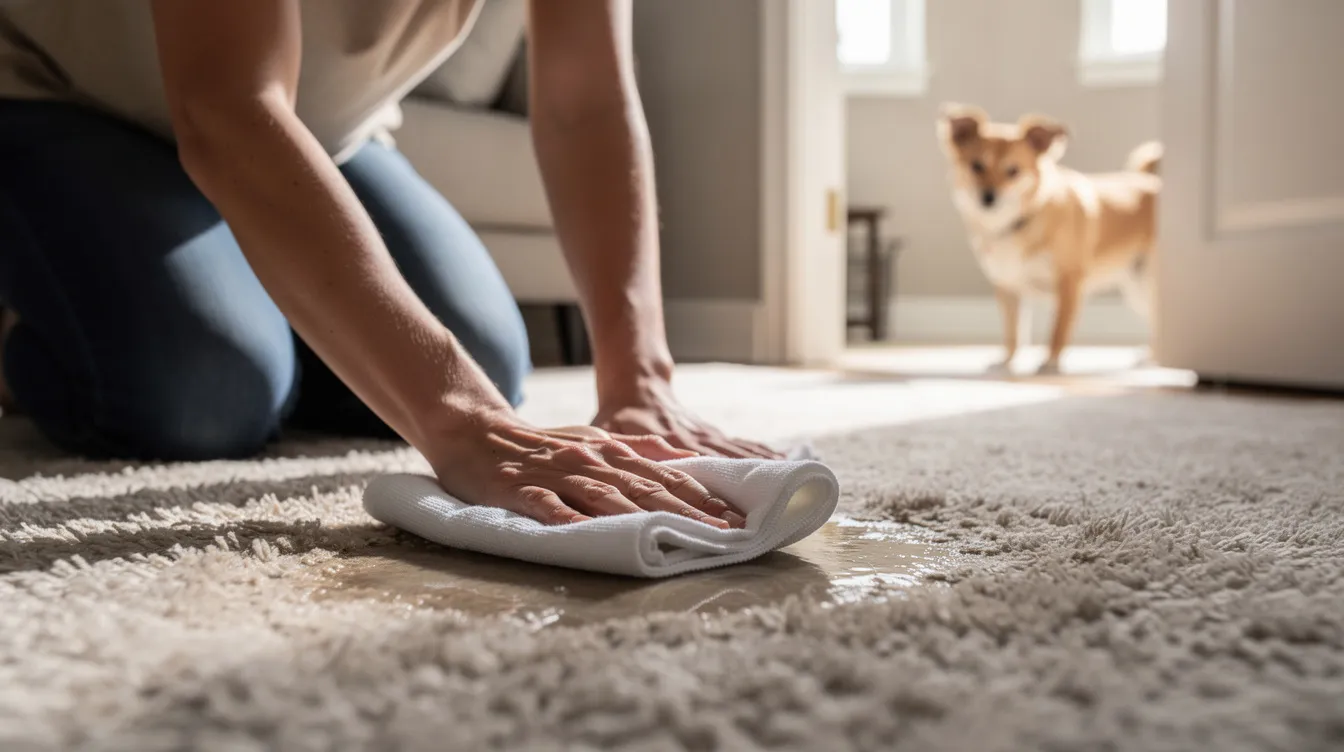
First Response: What to Do Right Away
- Move pets and kids away from the area so they don’t track it through the house.
- Use clean white towels or paper towels.
- Blot firmly. Do not scrub.
- Switch to fresh towels as they become damp.
- Keep blotting until the towels are only lightly damp.
- If you use a cleaner, choose one labeled for carpet pet accidents and follow the label directions exactly.
- Dry the area with normal airflow or a fan, and keep pets off the spot while it dries.
What Not to Do
- Do not scrub aggressively. That can spread the spot and rough up carpet fibers.
- Do not flood the carpet. Too much liquid can make a small problem harder to dry.
- Do not stack multiple cleaners on the same area. More product often means more residue and more guesswork.
- Do not keep retreating the same spot over and over if the smell returns after drying. At that point, surface cleanup may no longer be the real issue.
A Stop-or-Continue Guide Based on What You Can Observe
Use these checkpoints to choose your next action. They do not establish a cause, identify the affected layers, or guarantee stain removal.
| What you know | What to do next | What to record or ask |
|---|---|---|
| You witnessed the accident, the spot is small, and you have not applied a product. | Blot first. Check the carpet care instructions before deciding whether to use a compatible pet-spot product. | Record when you found it and photograph the visible area before treatment. |
| The carpet is still damp after your first cleanup. | Follow the product’s drying instructions. Don’t start a different treatment just because the area hasn’t dried yet. | Record what you applied and whether the visible area changed. Ask for advice if you can’t determine the next step. |
| The area appears dry, and you no longer notice odor or a visible mark. | Pause treatment and observe instead of adding another cleaner as a precaution. | Keep the record in case the same problem returns. This observation does not prove the backing or pad is unaffected. |
| Odor returns, a mark remains, or another accident happens in the same place. | Stop experimenting with additional products and request an assessment. | Explain which observation changed. Ask what can be checked before choosing a treatment. |
| You may not know when the accident happened, which products were used, or whether the carpet can handle them. | Tell the cleaner what you don’t know rather than guessing or trying another product combination. | Ask which carpet information or photographs would help them advise you. |
Keep the Cleanup Residue-Conscious
For a fresh accident, simpler is usually better. If blotting alone does not seem like enough, use only the amount of cleaner the label calls for, then let the area dry thoroughly.
If the carpet later feels tacky or seems to grab dirt quickly, Guardian Carpet Care’s guide on why carpet feels sticky after cleaning explains a common cause.
Keep a Short Cleanup Record
Copy these prompts into a phone note. This is a suggested homeowner handoff tool, not a diagnostic form or a claim about Guardian’s booking requirements.
- Location: room and a fixed reference point, such as beside the sofa’s left front leg.
- Timing: when you found the spot; say “unknown” if you did not witness the accident.
- Before: what you could see or smell, with a photograph if useful.
- Actions: blotting, exact product name, label directions followed, and any earlier treatments you know about.
- After: whether odor or the visible mark remained, disappeared, or returned; whether another accident occurred.
- Carpet information: manufacturer and care instructions if available. Do not guess the fiber type.
A Worked Example: Same Smell, Different Next Question
Imagine two households report “the smell came back.” In the first, someone saw a new accident in the same place after cleanup. In the second, nobody saw another accident and the owner noticed odor again after the original spot appeared dry. These are hypothetical situations, not Guardian customer cases.
The first household should report both events instead of describing them as a single failed cleanup. The second should report the return of odor and the earlier treatment without declaring that the pad is contaminated. Neither observation settles the cause. Both give the cleaner a more precise starting question than “Which stronger product should I try?”
When It Is Time to Stop Spot Cleaning
DIY stops being worth it when the problem keeps returning. Guardian Carpet Care’s public odor-treatment page frames odor work as source control: identify where the smell is coming from, then choose treatment.
That is usually the better next step when:
- The urine smell comes back after drying.
- Your pet keeps returning to the same location.
- You have already used several spot products and the area is getting harder, stickier, or more noticeable.
- The affected area is larger than a quick towel-and-fan cleanup can reasonably handle.
For more on that decision, see Guardian Carpet Care’s guide on how to tell if the smell is in the carpet or deeper below.
Questions to Ask Before Agreeing to Further Treatment
- What can you determine from an inspection, and what will remain uncertain?
- What treatment do you recommend for the condition you actually find?
- Do the products already used affect your recommendation?
- What result is realistic for the odor and the visible mark separately?
- What drying and pet-access instructions should we follow afterward?
Ask for the proposed scope and any limitations before proceeding. A useful assessment separates observations from assumptions; a homeowner’s photograph or smell report alone should not be treated as confirmation of hidden damage.
Guardian Carpet Care’s Approach for Placer County Homes
Guardian Carpet Care is a family- and veteran-owned company serving Lincoln, Rocklin, Roseville, and nearby Placer County communities. Its public service information describes specialty pet urine treatment as treatment designed to address odor at the source rather than simply mask it.
If you are arranging help in Guardian’s service area, have your cleanup record ready. Describe the problem and ask whether an assessment is the appropriate next step before selecting a treatment.
One Practical Reminder for Pet Owners
If accidents are sudden, frequent, or unusual for your pet, cleaning may not be the whole issue. Training, routine, stress, marking, and medical concerns can all play a role, so a veterinarian visit may be worth considering when the behavior changes unexpectedly.
Need help with a pet odor that keeps returning? Book service with Guardian Carpet Care.


